Master’s Speech at the 2026 Recommencement Dinner
Ormond College
AI is going to unlock extraordinary opportunities. But it also presents enormous risks, and I don’t think we yet fully understand either. That’s why it’s so important that we continue talking about it.
Tuesday 1 September 2026
Increasingly, we mistake being exposed to information, for actually understanding it.
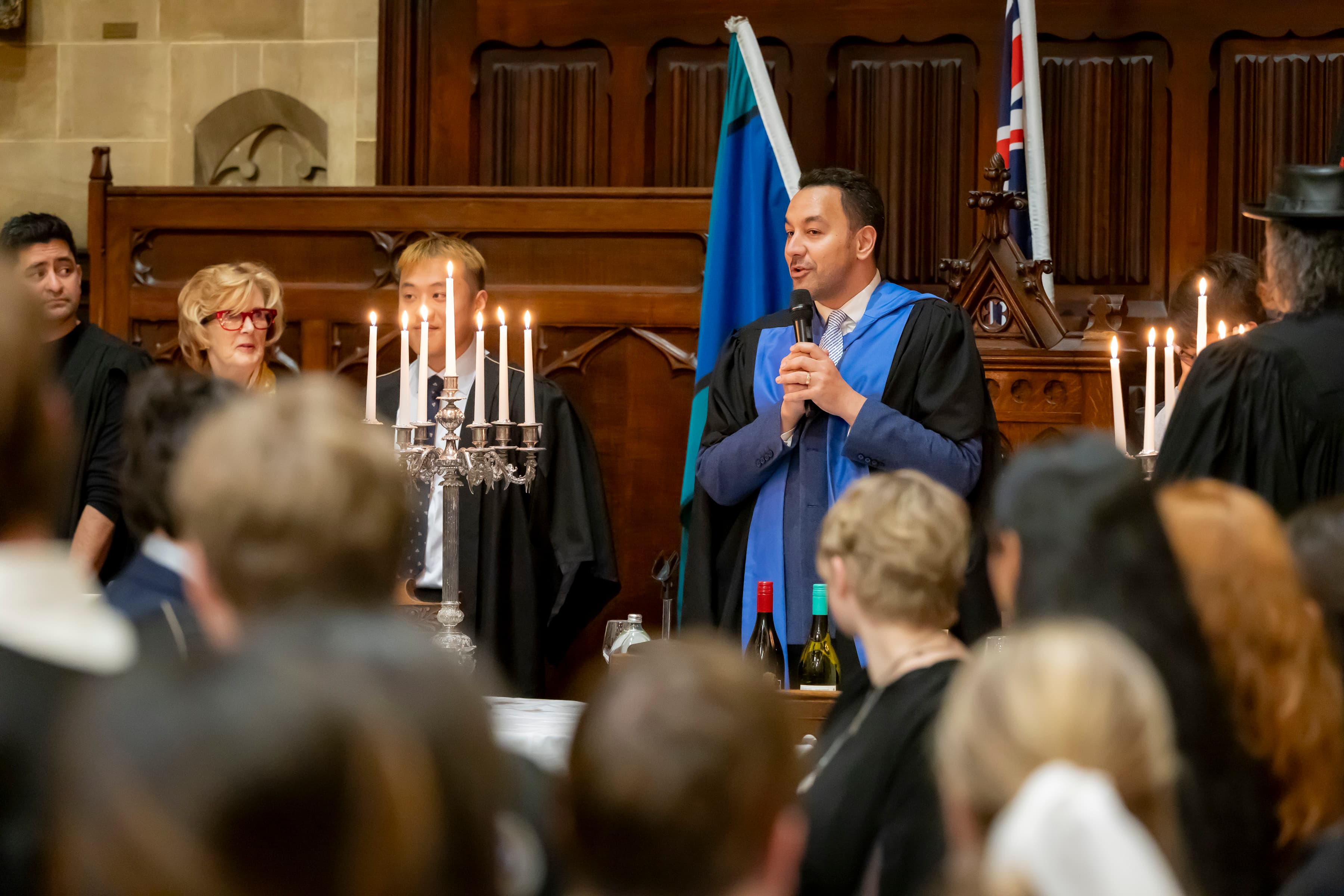
Good evening everyone. Welcome back, and a particularly warm welcome to the Re-Os. It feels like a while ago since I spoke to you all. Some of you have been in Europe working hard on the sun tans, although Mathias was on a leadership program so he wins the prize for most diligent Ormondian in Europe over the winter break. Some of you have been on Ski Week, or Play Week. Freshers were dressed up as Smurfs on Monday for who knows what reason. And of course, Anton Robinson superbly represented Ormond with me at Cambridge University proving that it is, in fact, possible to have a holiday while still making the Master look respectable.Anyway, it’s so good to see you all tonight and to be here to celebrate the start of Semester Two. For some of you this is your first formal hall, and for others of you, this is the beginning of the end. [Ok, that was supposed to be funny but my dad jokes never seem to land]. What I meant by that is that for third years, in particular, this is the last semester of dining in this beautiful place, and believe me it is going to go by really quickly so make the most of it! I was actually planning to spend tonight talking about AI (surprise, surprise) because it is one of the most defining issues in education today. You’ve heard me speak about AI lots this year. It was the topic of my Semester One letter, and I mentioned a while back that we have established the AI and the Future of Learning Advisory Group, bringing together students, staff and external experts to help us think through the opportunities and challenges AI presents.But tonight I only want to touch briefly on AI before I move on to what I really want to talk about.Every person in this room should be thinking carefully about how you use AI. Thinking about what you are doing to utilise this extraordinarily powerful tool while also ensuring you continue developing your own brain and deepening your own thinking.When I think of AI in your lives, the question I keep coming back to is this: are you using AI to support your brain development and your intellectual growth, or are you using AI instead of it?I’ve been spending a lot of time talking with leading professors in the AI space, industry leaders, and AI engineers. Just recently I watched a fascinating hour-long conversation between Elon Musk and the Editor-in-Chief of The Economist about AI and the broader direction of the world. What fascinated me wasn’t that Elon Musk thinks AI will make us more productive. It was that he believes AI could end the age of scarcity. He described an ‘age of abundance’ in which intelligence is effectively unlimited, physical labour can be performed by robots, and the constraints that have shaped human civilisation for thousands of years begin to disappear. Whether he’s right or wrong, that’s an extraordinary proposition. It forces us to ask not simply what AI can do, but what kind of world it might create.I don’t want to be a scaremonger. AI is going to unlock extraordinary opportunities. But it also presents enormous risks, and I don’t think we yet fully understand either. That’s why it’s so important that we continue talking about it.Last semester, around 270 of you completed the AI section of the student survey. I’ve read through every response. What struck me was just how mixed the feedback was. Some of you are embracing AI. Some of you are hesitant. Some of you are using it every day. Others aren’t particularly confident about how to use it well. And for many of you, there’s still genuine uncertainty about where AI fits into your learning and your life. That tells me we’ve got a lot more work to do.Yes, the University has a role to play. Yes, Ormond has a role to play. In fact, I think we’re uniquely placed to have the kinds of conversations that often can’t happen in a lecture theatre. But ultimately, this is your responsibility. It’s up to you.You need to do the work to understand one of the most significant technologies that will shape your life and your career. The world is already being transformed by AI. And it’s only going to become more so in the weeks, months and years ahead. And when I say weeks, I mean weeks. Almost every day there are new developments that make AI more capable, more powerful and more useful. More people are using it every day too.Which means your greatest asset won’t simply be knowing how to use AI. It will be your ability to think. To think uniquely. To think like only a human being can.And that brings me to what I actually want to talk about tonight. The world around us.Let me ask you a few questions.How many of you even knew there is currently a Royal Commission into Antisemitism and Social Cohesion? Did anyone make a submission? How many of you have been following what’s been happening in Iran over the past few weeks? How many of you could explain why the Strait of Hormuz matters?And finally, how many of you actively seek out the news every day? And I don’t mean scrolling Instagram or TikTok, I mean deliberately going to independent and verified news sources because you genuinely want to understand what’s happening in the world.These are not abstract issues. The Royal Commission is examining fundamental questions about antisemitism, social cohesion, freedom of expression and what kind of country we want Australia to be. At the same time, conflict in the Middle East has reminded us just how interconnected our world is. Around a fifth of the world’s oil passes through the Strait of Hormuz. If that shipping lane is disrupted, energy prices rise, inflation follows, economies are affected and Australians feel it too. Events taking place thousands of kilometres away shape our lives here in Melbourne far more than we sometimes realise.When I was at college, twenty or so years ago, we used to gather around the television every evening to watch the 6 o’clock news. It wasn’t because we were political junkies. Well, maybe some of us were. And yes, before anyone says it, we also didn’t have smartphones or social media. But we were curious. We wanted to understand the world we were about to enter.And that’s something I worry about today.We are probably more ‘connected’ than any generation in history, in yet many ways we are less informed. News finds us, rather than us seeking it out. Algorithms decide what we see. Increasingly, we mistake being exposed to information, for actually understanding it. And, increasingly, too, information is presented as fact when it simply isn’t.One of the things that surprises me is how many young alumni I catch up with, a year or two after they’ve left Ormond, tell me they were surprised by what the world expected of them. Nobody sat them down and said, "You should know what's happening in the world." It was simply assumed. Whether it's around the board table, in the staff room, or the laboratory, people expect them to understand context. To know what was happening in Australia and in our region. To contribute thoughtfully to conversations. To exercise good judgement.That's what educated people are expected to do. Of course, one of the great strengths of Ormond is community. You will build friendships here that will last a lifetime. You’ll develop networks that many people never have the opportunity to develop. But one of the things I want us to continue strengthening is our engagement with the world beyond these gates.That’s why I asked for the television in the JCR to have the news on. That’s why we brought newspapers into the JCR last year, although I think everyone was cutting out the crosswords or sudoku, so they were taken away. But you can find them in the library, every day. Go and read them. It’s also why we work so hard to bring interesting speakers to Formal Hall, fireside chats and other events. And it’s also why I hope Fridays-at-One never becomes an echo chamber. I don’t come along anymore because I genuinely think that’s your space. But I hope you’re using it well. If everybody walks out of Fridays at One agreeing with one another, then it’s a waste of time. Universities and colleges should be places where ideas are tested, assumptions are challenged, and people learn how to disagree well. You don’t grow intellectually by only hearing from and engaging people who think exactly the way you do.You are all now at an age where you should actively encourage people with different perspectives into the room. Invite people to challenge your assumptions. Listen respectfully. Argue respectfully. That is what education is all about.Now, with all that said, let me leave you with four challenges for this semester: First, make it your business to know what’s happening in the world. And don’t just wait for the news to be placed in front of you, although I would like to think you’ll occasionally look up at that news screen in the JCR. Don’t assume that because something appears in your social media feed you’re well informed. Make a habit of actively seeking out independent, verified news every day. Know what’s happening in Australia. Know what’s happening in our region and internationally. And know why it matters.Why? Because before you can have an informed opinion, you first need to know what’s actually going on. And because one day the responsibility for this country, these institutions, these businesses, schools, and communities will belong to your generation.Second, put yourself in rooms where your ideas will be challenged. That’s Fridays-at-One. It’s academic intensives. It’s fireside chats. It’s random conversations over dinner. Don’t spend your time only talking to people who think exactly as you do. Seek out people who disagree with you. Learn how to change your mind when the evidence is clear. Third, help shape the intellectual life of this College. Don’t simply consume what Ormond offers. Create it. Tell me, and tell the team, who you want to hear from. Who would make a great Formal Hall speaker? Who would lead a fascinating seminar? Who would provoke a really good debate? We are the largest residential college in Australia. We have an extraordinary alumni network, wonderful parents and friends of the College, and people doing remarkable things all over the world. I honestly can’t imagine there are many people we couldn’t persuade to come and spend time with you if there was someone you genuinely wanted to hear from.But here’s another challenge. Don’t just suggest people you already agree with.Last semester, when we tested the names of a few possible speakers, there was push back on a few of them. That’s okay. But we don’t just invite speakers because we endorse everything they think or say. Sometimes we invite people we disagree with because they will challenge us. Because they’ll make us think. Because they’ll expose us to a perspective we may never have seriously considered before.I've always argued that universities, and colleges especially, should not be comfortable places. Safe, yes. They should be safe. Comfortable, no. They shouldn't always be comfortable. Safe means every person here is treated with dignity. Safe means every person here belongs. Safe means you can express your views without fear of intimidation or abuse.But comfort is something different. Comfort is where ideas go unchallenged. Comfort is where assumptions are never tested. Comfort is where you only hear from people who think the way you do. That isn't Ormond.Your time at Ormond should stretch you. It should challenge you. It should sometimes make you intellectually uncomfortable. Not because people are attacking you. But because your ideas are being tested. That's how good judgement is developed.So don't be afraid to suggest speakers who might challenge you. People who will make you think. People who will provoke debate. People who might even make you a little uncomfortable. Because that's often where wisdom begins. And it’s kind of why all of this matters.And finally, fourth, don't mistake being well qualified for being well educated. Those are not the same thing. A degree gives you a framework for thinking and doing. Education should cultivate judgement. It should help you understand people unlike yourself. It should help you understand the world as it is, not simply as your algorithm presents it to you. And it should prepare you to lead in a world that is becoming more complex, more contested and, thanks to AI, changing faster than at any point in our lifetimes.Those big iron gates of Ormond are not here to separate you from the world. They're here to prepare you for it. Those gates should sometimes be closed. Closed when you need the safety, support and community this place provides. But they must also be open. Open to new ideas. Open to different perspectives. Open to the world beyond this College. Because that's where your judgement will be tested. And that's where wisdom is formed.My hope is that when you leave this place, people won't simply say you graduated from Ormond. They'll say you understood the world. They'll say you exercised good judgement. They'll say you were wise. Because in an age when AI can generate knowledge in seconds, wisdom may become the rarest and most valuable quality of all.So, welcome, or welcome back to Ormond. Here’s to an engaging, safe, challenging, formative, and sometimes uncomfortable, Semester Two. Enjoy it, and look after one another while you’re at it. Welcome home.